Trust & direction.
The strategy behind every Sprout decision, in public. Five pillars, one commitment — and the reasoning for why a design system for tradespeople optimises for calm over flash.
Aceve builds the most trusted software in construction and skilled trades — calm, honest tools that feel like they were made by people who understand the job, amplified by AI that works like a reliable colleague.
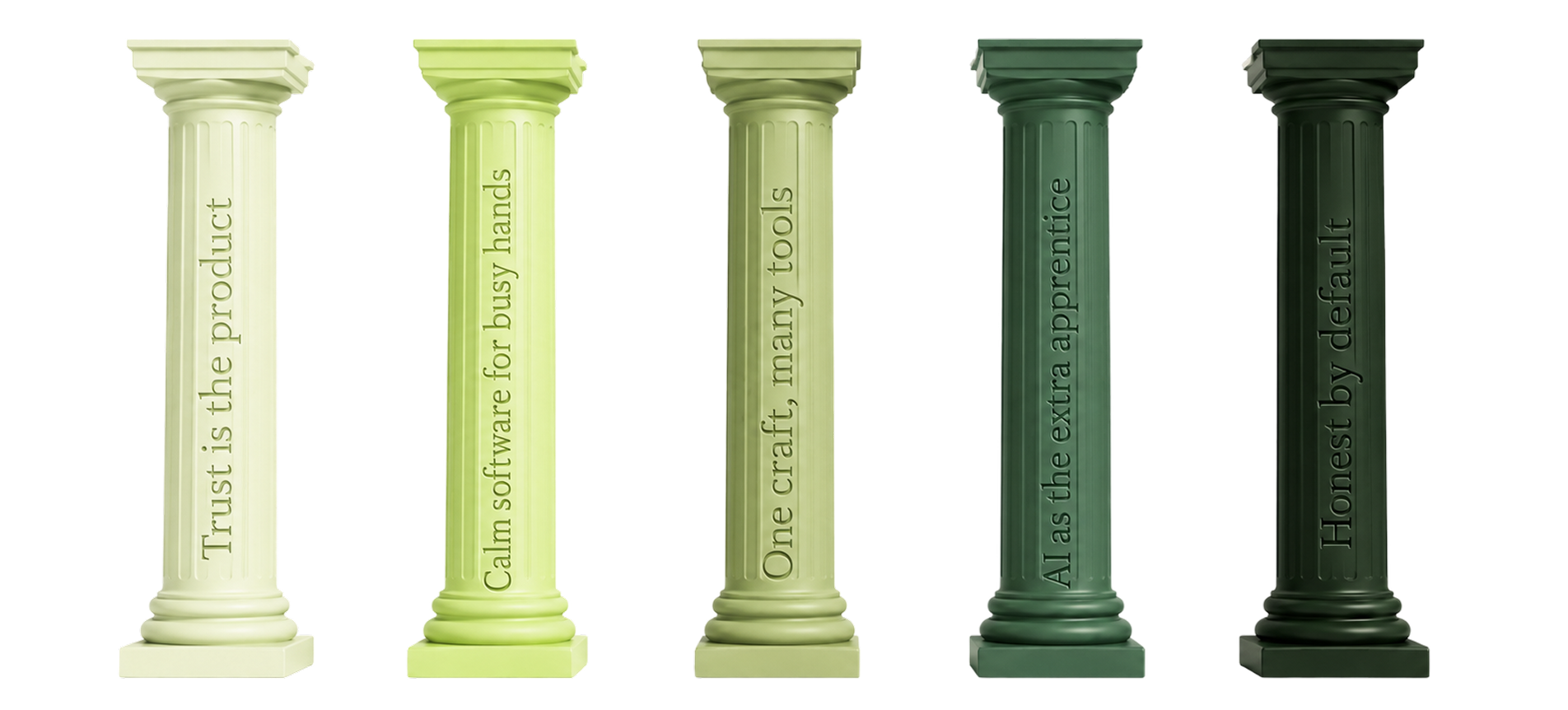
The five pillars
Each pillar states what we believe, what it means in practice — and what we will not do.
Trust is the product
In a market where every competitor now claims AI and features converge, trust is the last durable advantage. For a tradesperson, trust is uptime, data safety, predictable behaviour, and a human who answers in their language.
Reliability and offline resilience are headline features. We design for the worst day, not the demo. Local language, local compliance and fast human support are part of the experience, not extras.
Ship flashy features that compromise reliability. Bury data-handling or AI behaviour in fine print. Treat support as a cost to minimise.
Calm software for busy hands
Our users' primary job is their trade, not operating software. The best tool asks for the least attention and works even when conditions are bad.
Progressive disclosure — minimum on load, depth on demand. Graceful degradation on the job site. Features arrive slowly, built on familiar behaviours. Boring, predictable, dependable is the aesthetic.
Overload screens to look “powerful”. Interrupt users with notifications that serve us more than them. Redesign for novelty's sake.
One craft, many tools
A group of 28+ products should feel like one trustworthy family, while each tool stays expert in its trade and market. The design system is how we get both coherence and speed.
Sprout is the shared layer — tokens, components, patterns, personas and documentation, maintained as group infrastructure on aceve.design. New acquisitions adopt the design layer and inherit quality without losing domain depth.
Force a single rigid UI that erases legitimate trade-specific differences. Let every product reinvent the same components. Centralise for control’s sake where local fit matters.
AI as the extra apprentice
AI should free our customers to do the skilled work only humans can do — not replace them, and not demand their attention. It is a digital teammate that handles the paperwork.
AI is embedded in existing workflows, opt-in before default, framed in outcomes — “get paid faster” — not technology. It shows its receipt: sources, confidence and a human-confirm step for every consequential action.
Force a chatbot on users who didn't ask for one. Let AI act irreversibly without consent. Over-promise capabilities or hide that AI is involved.
Honest by default
Honesty is both a Nordic design heritage and a trust strategy. Lagom — not too much, not too little — is exactly what time-poor users need. Form follows function; nothing is ornamental.
Plain language over jargon. Transparent pricing, clear states, truthful empty and error screens. A calm, legible, distinctly Nordic visual identity — not a copy of generic SaaS minimalism.
Use dark patterns, hype, or manufactured urgency. Chase design fashion that says “serious” but means nothing. Let marketing language outrun product reality.
The trust commitment
To every customer, in plain words.
We will never trade your reliability for our novelty. We will tell you when you're working with AI and let you decide. Your data is yours and it is safe. We will speak your language, follow your country's rules, and answer when you need us. We will introduce change gently and always leave you a way back.
How we measure it
Trust is a feeling; these are its instruments.
The pillars live in the product through the eight design principles, the adoption pyramid and the AI patterns — this page is the why, those pages are the how.